
UX Design Case Study
Understanding the Travel Needs of
Neurodivergent Millennials
Human Centered, Inclusive & Accessible

ZenRoute is a travel booking web application created to support neurodivergent millennials with their travel needs. Unlike traditional travel apps that emphasize on speed and pricing, ZenRoute focuses on clarity, and a sense of control, empowering users to plan travel with greater confidence and ease.


Problem Statement
Most digital travel platforms still fail to support the unique needs of neurodivergent millennials, particularly around planning, budgeting, and managing sensory-friendly, low-stress experiences. Traditional travel and finance tools assume neurotypical behavior and overlook challenges like executive dysfunction, information overload, and sensory sensitivities. There is an opportunity to design a user-centered solution that offers financial flexibility, personalized travel options and cognitively accessible travel planning, empowering neurodivergent millennials to travel with greater confidence and comfort.

My Approach to the Design Process
Years of firsthand experience in the travel industry, brought awareness to continuous accessibility gaps for neurodivergent millennial travelers. The goal was to understand how neurodivergent Millennials experience current travel booking platforms specifically where confusion, overload, and frustration occur. Mostly during planning, budgeting, and booking.
Research Methods

User Surveys
35 Participants

Affinity Mapping
Identified patterns across surveys

Heuristic Analysis
Visibility of system status

User Interviews
"This should feel less stressful!"

Competitive Analysis
Too much cognitive overload

User Testing
5 Participants
Reseach Findings & Insights

lack of personalized options
Clear, personalized options will help users quickly identify choices that match their needs without forcing them to sift through overwhelming or irrelevant information. For example, an inclusive travel platform could offer filters and recommendations based on preferences such as quiet environments, flexible cancellation policies, budget limits, or accessibility features.

limited budget tracking
Improved budget tracking allows users to understand and manage travel costs in real time, helping them make informed decisions without stress or uncertainty. This would include visual breakdowns of costs, alerts when nearing a budget limit, and simple summaries of what is refundable or covered by credit card benefits can further support clarity.

absence of neurodivergent compliant resorts
Neurodivergent-compliant resorts are accommodations designed to support sensory comfort, predictability, and emotional well-being for guests with diverse cognitive and sensory needs. These resorts may offer quiet zones, low-sensory rooms with adjustable lighting, minimal noise, flexible check-in and dining times, and staff trained in neurodiversity awareness.
Research Insights to Business Value
Turning these findings into actionable insights, would benefit the company and travel industry, by improving both the customer experience and business performance through inclusive design.


Empathy Map

User Personas

"I need reassurance, not more choices!"
"This shouldn't feel this stressful!"

Survey Results &
Qualitative Analysis
Designed and distributed an online survey, with the use of Qualtrics, to better understand how neurodivergent millennials plan, budget, and book travel. The survey consisted of clear, structured, and accessible language to minimize avoid leading questions. Participants were given the option to skip questions or provide open-ended responses, allowing for flexibility and comfort. Questions focused on booking habits, pain points with existing travel platforms, sensory overwhelm, navigation clarity, and confidence during decision-making.


Quotes
Participants were allowed a section in the survey to disclose their pain points. Here is what some of them had to say...
Participant 5
"The hotel that I had booked was in a neighborhood I was not expecting, and the quality of the hotel was significantly less than I had expected."
Participant 16
"Any time I travel I have a very hard time, becoming very overwhelmed with comparing prices and options for just about anything, including hotels and entertainment and travel arrangements."
Participant 22
"My app kept defaulting back to original settings, and it didn't save anything I had changed"
Heuristic Analysis
American Express Website

Competitive Analysis Findings
-
Mainstream platforms prioritize efficiency and features: American Express Travel, Expedia, and Booking.com offer robust functionality and streamlined booking capabilities.
-
Cognitive overload is a key issue: Dense layouts, redundant navigation, and prominent non-actionable information can make travel planning overwhelming.
-
AutismTravel.com prioritizes accessibility: It provides greater clarity and reassurance for neurodivergent travelers.
-
Accessibility comes with limitations: AutismTravel.com lacks the streamlined booking flows and scalability of larger travel platforms.
-
Design opportunity: Combine the efficiency and trust of mainstream platforms with the clarity, guidance, and cognitive accessibility of autism-centered solutions.

User Flow Chart
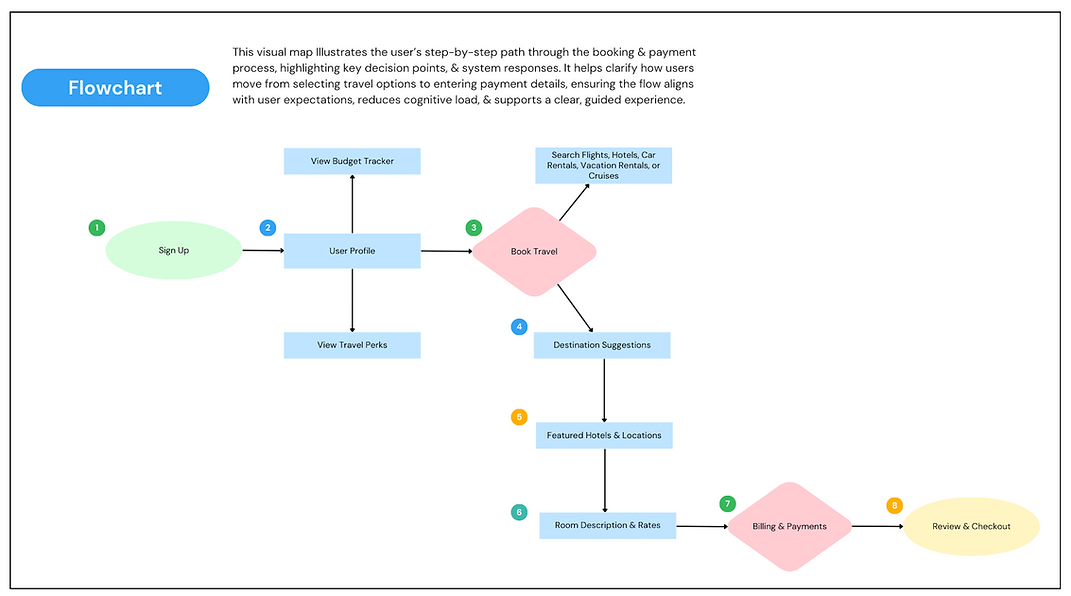
Low Fidelity Sketches
Sign Up

Profile

Travel Search

Membership Points Tracker

Low Fidelity Wireframes
Sign Up

Budget Tracker

Travel Search

Destination Suggestion

Traveler Information

Billing Information

Check Out

Medium Fidelity Wireframes
Sign Up

Low Sensory Hotels

Profile

Accomodation Options

Travel Search

Budget Tracker

Membership Points Tracker

Check Out

A/B & Usability Testing
Five participants independently tested the prototype in their own time. After completing the tasks, I conducted follow-up interviews to evaluate usability, identify points of friction, and gather feedback on opportunities for improvement.
I shared a second version of the prototype with the same participants, which included a brief survey designed for users who travel less frequently and needed additional support when choosing a destination, as well as additional compliance alerts for comparison.
I then conducted a second follow-up interview with participants to gather comparative insights between the two versions.
Key Findings
-
Participants responded positively to the guided, step-by-step booking flow, noting it reduced overwhelm and increased confidence.
-
Redundant navigation and repeated booking links caused momentary confusion about where to start.
-
Prominent alerts and informational messages were often interpreted as errors or warnings, creating unnecessary anxiety.
-
Users wanted clear confirmation and reassurance before completing payment.
-
Simplified layouts and consistent visual hierarchy made the experience feel calmer and easier to navigate.
-
Less frequent travelers benefited from added destination guidance, reporting increased confidence when choosing a destination.
-
Additional compliance alerts increased cognitive load and were often perceived as unnecessary or distracting.
-
Guidance was most effective when tailored and optional, rather than persistent.
Design Changes Made
1
Destination Suggestion
Optional
Kept destination suggestion for users who travel less frequently, presenting it as optional and contextual rather than mandatory.
2
Reduced Compliance Alerts
Reduced the number of compliance alerts, removing those that were repetitive or non-actionable.
3
Repositioned Alerts
Repositioned necessary alerts to appear later in the flow or as subtle inline text instead of prominent messages.
4
Simplified Booking & Results Interface
Simplified the booking and results screens to minimize visual noise and reduce cognitive load.
5
Strengthened confirmation Cues
Strengthened confirmation cues during checkout to increase user confidence before payment.
What's Next ?
-
Further develop the chatbot assistant Zena, adding more value to users.
-
Incorporate "AI - Guided Destinations." With this feature AI could analyze user preferences, past travel behavior, budget, and sensory needs to suggest destinations that align mostly with them.
-
Test with a larger and more diverse group of neurodivergent users with varying travel experience levels to further validate adaptability.


